World Heritage Sites of Bangladesh
We as human beings crave for attention and validation. However, once we do get it we do not know how to cherish and preserve the glory. The same applies for our World Heritage Sites

A World Heritage Site is an area, landmark or an establishment that are identified and designated by United Nations Education, Scientific and Cultural Organization (UNESCO) for having cultural, historical and scientific relevance or importance. These said areas or landmarks are entitled to legal protection by an international convention passed under the mandate of UNESCO. The name for the said convention is "Convention Concerning the Protection of the World Cultural and Natural Heritage". It was adopted by the General Conference of UNESCO on 16 November 1972 and has been ratified by 193 UN member states. The purpose of having world heritage site is to cherish, celebrate and pay homage to these places and the ideas they represent. It is also a tribute to the creators of these sites. The main idea is to pass on the cultural and historical legacies these places carry on to the next generation. The international legal convention ensures the safeguarding of these places by protecting them from any sort of harm.
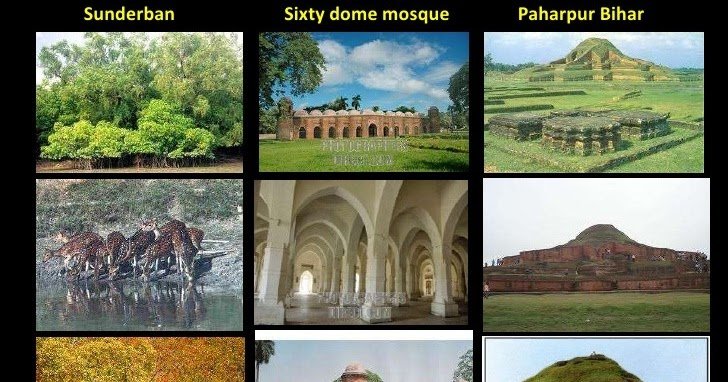
fig: Collected
World Heritage Sites in Bangladesh
Bangladesh as of now has three World Heritage Sites. They are:
- Shat Gombuj Masjid in Bagerhat, Khulna
- Sundarban Mangrove Forest in Khulna
- The Buddhist Bihar at Paharpur.
UNESCO expects every member states to nominate new places each year to be designated for the World Heritage Site. The nomination list for Bangladesh was last updated in 1999 and it has been 21 years since then that new sites were nominated. Even if we look past such sad and shameful laziness of the concerned authorities and instead concentrate on the current status quo of the existing sites, it is even a more horrid tale. All three places have deteriorated over time due to lack of care from the administration. Calling them a heritage site feels like an over state. These places are in a sorrow state and what used to be a bearer of proud Bangladeshi legacy now lies in shambles.
We as human beings crave for attention and validation. However, once we do get it we do not know how to cherish and preserve the glory. The same applies for our World Heritage Sites. Each of these places was accredited with designations because of the cultural and historical relevance they carry in the context of our country. By turning a blind eye to these sites, we are turning a blind eye to our heritage and cultural roots. It is high time for us to understand the significance of these places and restore them to their former glory. We are so often caught up in the bureaucratic cobweb that we forget the things that truly matters. It is high time we start taking care of these sites and nominate new sites for this prestigious title. Bangladesh is land of countless potentials and it is up to us to glorify our country in front of the whole world through exploring these potentials.
In this article we will take a brief glimpse at two of the World Heritage Sites in Bangladesh:
- Shat Gombuj Masjid
ShaatGombuj Mosque is a World Heritage Mosque in Bangladesh located in Bagerhat district of Khulna Division. As there is no inscription of the mosque, no exact information was found about the founder and the construction period of the sixty dome mosque. However, it is believed that Khan-i-Jahan built it in the 1500th century because of the mosque's architecture. The stones used in this mosque were brought from Rajmahal. The 60-domed mosque is one of the World Heritage Sites in Bangladesh. UNESCO gave the city of Bagerhat the status of a World Heritage Site in 1983.
The structure and description of Shat Gombuj Masjid
The mosque is about 160 feet tall to the north-south on the outside and about 104 feet tall to the east-west. And from the inside it is about 143 feet tall on the north south side and on the east-west side about 88 feet tall. The walls of the mosque are about 8.5 feet thick. On the east wall of the mosque there are 11 huge arched gates. The middle door is larger than the other doors. And on the north and south walls there are a total of 14 doors, 7 on each side. The mosque has four rounded minarets at its four corners. Each tower has a circular dome. The minarets are a little higher than the roof corners.
One of the two minarets at the front of the mosque is named RoshanKotha and the other is called Andhra Kotha. Inside the minaret is a spiral staircase, which was previously used to offer azan from this tower. There are sixty pillars inside the mosque. The pillars are arranged in a row of 6 from north to south, 10 on each row. Each pillar is made of stone but the five pillars are covered with brick. The dome was built on the roof around the pillars. Sixty Dome Mosques have a total of 77 domes in 11 rows. And the total number of domes is 81, with four domes on the tower. Except for the seven domes in the row between the mihrabs of the mosque, the remaining 74 domes are semi-circular.
- The Sundarbans Mangrove Forest
Considered a natural wonder, the Sundarbans is the largest mangrove forest or saline forest in the world. The total area of the Sundarbans is approximately 10,000 sq km jointly between Bangladesh and India. Bangladesh covers 6,017 sq km. Khulna, Satkhira, Bagerhat ,Patuakhali and Barguna Districts makes up the Sundarban of Bangladesh. In 1997, UNESCO recognized the Sundarbans as a World Heritage Site.
Calling the Sundarban a museum of life and plant would be a gross understatement as its rich in biodiversity and wildlife. The Sundarbans cover 1874 sq km consisting of forests, rivers and lakes. Sundarbans are well-known for being home to numerous species of birds, including the Royal Bengal Tiger, deer, crocodiles and snakes. There are about 350 species of plants, 120 species of fish, 270 species of birds, 42 species of mammals, 35 species of reptiles and 8 amphibians.
The forest is named after the beautiful tree named Sundar. Waterway is the only way to get inside the Sundarbans. Winter is the perfect time to visit the Sundarbans.
Sundarbans is a great source of income not only for the south-western region of Bangladesh but also the whole country. It is the largest source of forest produce in the country and generates massive employment for the entire region. It provides the raw materials for a lot of essential industries of the country such as news mills, hatcheries, wood and furniture building. It goes without saying, that it is an aesthetic tourist attraction and thereby a great source tourism revenue. Therefore, its role in the economy cannot be understated.
Written by,
Muksetul Alif
Information Collected